

Years ago, before what he used to call “Outlaw Nights”, my friend Zak introduced me to the phrase “Everything in moderation, including moderation”. It makes sense, moderation is important, but every once in a while, you need to go wild and just indulge. Get out and enjoy yourself, and don’t stress about it. Just remember to pull back to moderation when you’re done. That’s the philosophy I take during the winter holiday season. I’m going to eat, drink, and indulge in whatever I want for those couple of weeks. It’s feast time. Then, when it’s over, and the calendar flips to January 2nd, I’m back to being good, mostly.
That’s the concept of Dry January, something people practiced for years until it became an official thing in 2014, developed and delivered by UK charity Alcohol Change UK. Since then, it has spread, and estimates are that up to 13-15% of Americans participate in this tradition of abstaining from alcohol in January. Although I don’t normally participate in Dry January, I commend those who do.
Unfortunately, I was forced to participate in Dry January this year, though. Joining me in this abstention from drink were the rest of the plants and ecosystems throughout Central and Southern California. And the fluid we didn’t get wasn’t alcohol, it was rain. We had a wonderfully wet November and December; the rivers rose, reservoirs gained water, and the hills turned green, but come January, it stopped. The tap from the Pacific turned off, and it’s been dry ever since. Well, to be truthful, there was a ¼ inch of rain that fell one night just in Los Osos and Morro Bay, but other than that, it’s been dry, dry, dry, and unseasonably warm with temperatures in the 70s and even 80s.
People are constantly remarking about what lovely weather we’re having. While I understand what they mean, it irritates me. If it were April or May, I would agree with them, but we are in the middle of our rainy season and need to be banking water and snow. Rainy days are lovely weather this time of year.
Those warm “lovely weather” days also have a dark side. The plants are confused, and many native plants and fruit trees around the area are budding or blooming weeks or months ahead of schedule. This has implications for wildlife, especially birds. Many insects time their breeding and egg-laying with the plants' peak growth, which is before blooming. That way, their larvae/caterpillars will have lots of food. These, in turn, are a critical food source for nestlings of neotropical migrant birds that breed in California. Unfortunately, these birds stand a chance of missing out on this feast because they have yet to migrate back to our area. This is just one of the impacts of a warming world.
Now, I know some of you may be thinking, wait, how can we talk about global warming when there is snow falling in Florida, and most of the eastern half of the country has been in a deep freeze for weeks? Good question, I’m glad you asked it. Let’s nerd out on some weather basics for a bit.
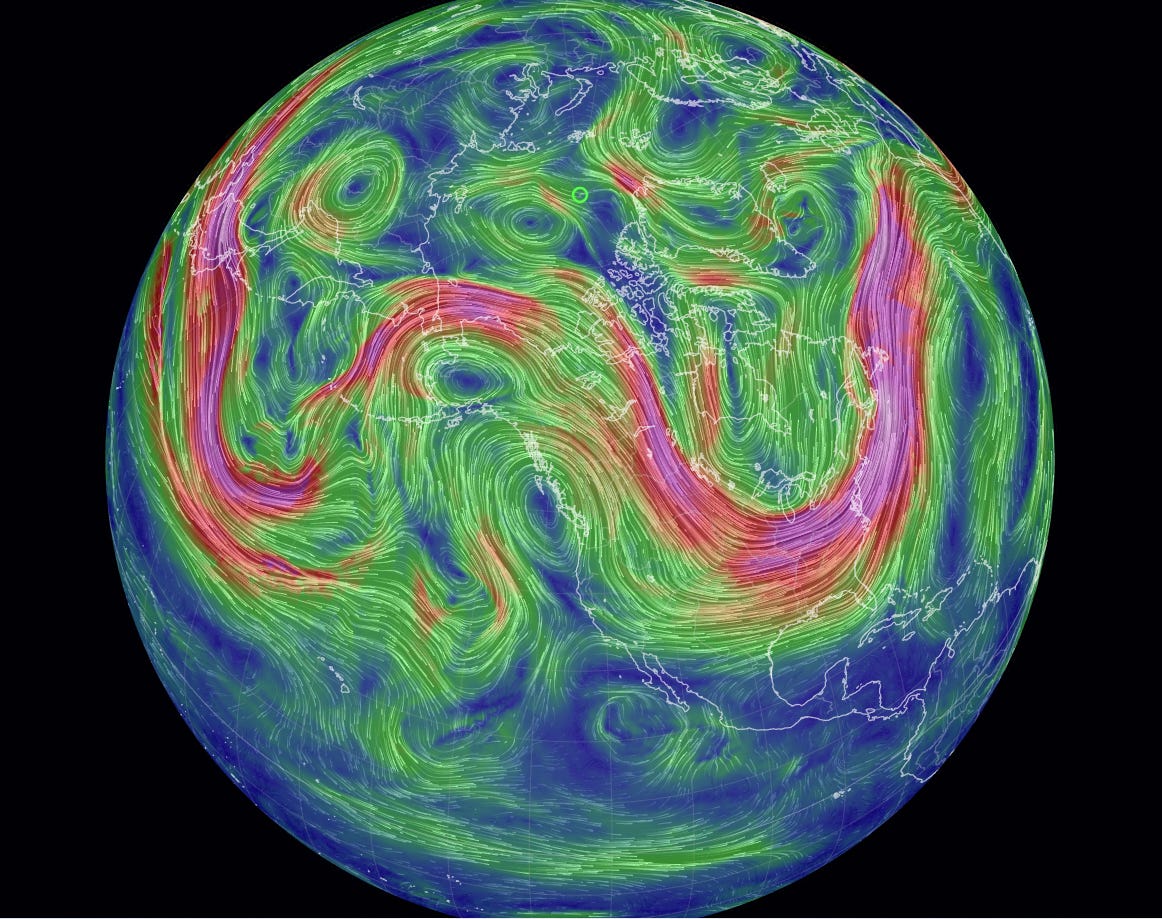
The east is cold because the west is warm. The West is warm due to a blocking ridge, or bubble of high pressure. Look at the map at the beginning of my post, and you will see the omega-shaped jet stream that results from being blocked by the high pressure over the west coast. This pushes the upper-level air up over the Arctic and Canada, where it cools, then shoots that frigid air into the Midwest and south, causing ice, snow, and record low temperatures. These undulations are what scientists call atmospheric Rossby Waves. There’s a cool video below from the NOAA website showing them.
Rossby waves naturally occur in rotating fluids. Within the Earth’s ocean and atmosphere, these planetary waves play a significant role in shaping weather. This animation from NASA’s Goddard Space Flight Center shows both long and short atmospheric waves as indicated by the jet stream. The colors represent the speed of the wind, ranging from slowest (light blue colors) to fastest (dark red).
So, yes, record lows have been set in the United States and other areas. But most of the planet has seen a strong decrease in extreme cold events, most notably in the high-latitude northern hemisphere regions. The worldwide trend is that record highs currently outpace record lows by a 2-to-1 ratio, and that ratio is rising rapidly. See the chart below.
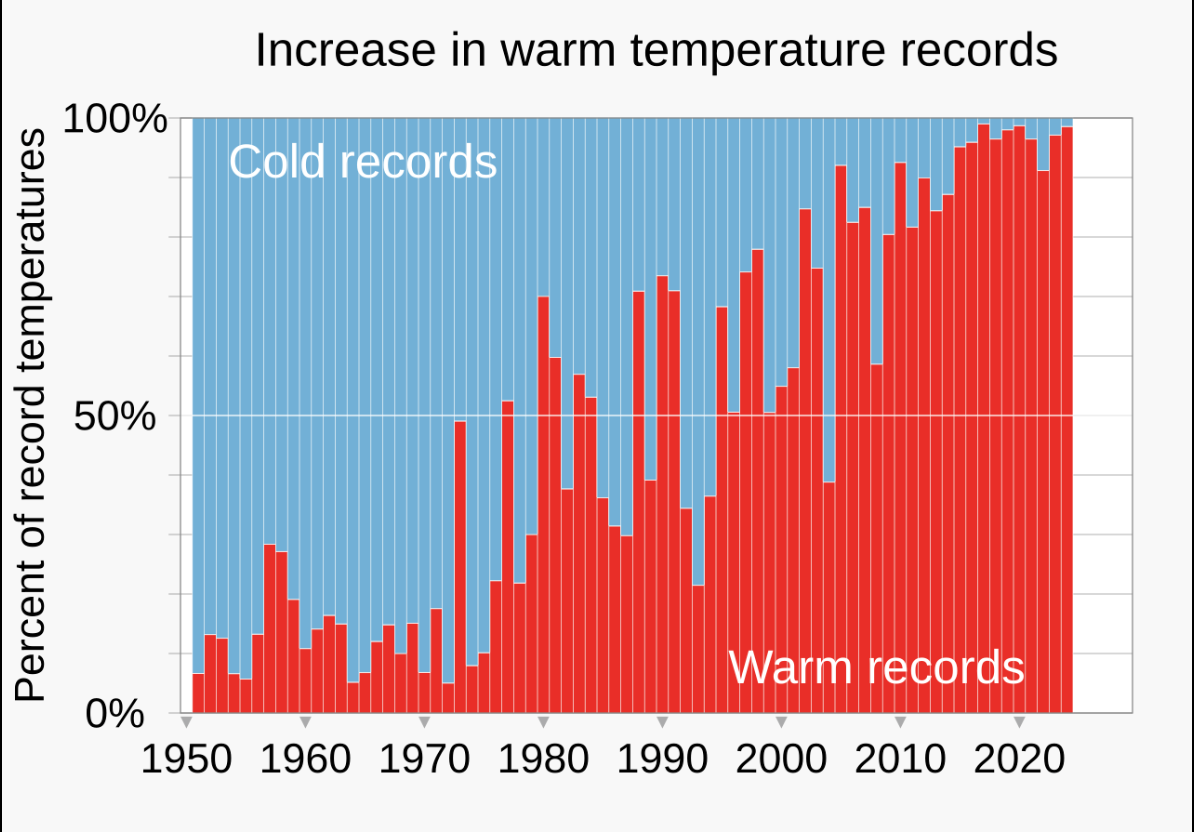
This ratio disparity ties into our Dry January because one of the drivers of our jet stream is the temperature difference between the cold air over the Arctic to the north and the milder air to the south. As the Arctic warms, it loses sea ice, which normally reflects energy from the sun. Instead, that energy is now absorbed by the ocean, causing further warming, which reduces the difference between the regions' temperatures.
Theories indicate that as the Arctic warms, it could alter the strength, position, and duration of these blocking events in the northern hemisphere, making them more frequent. We’re already starting to see that happen in weather patterns around the globe, with stationary air masses that sit around creating extended periods of heat or cold.
Some researchers claim this is no different from situations in the past, but time will tell how this all plays out. Especially as we humans continue to conduct this long-term experiment of increasing carbon dioxide levels in our atmosphere to levels never before seen in human history.
Thankfully, we’re not having a dry February! As I sit here, I’m watching the white-crowned sparrows take baths in the waterdrops left on the grass blades by the recent storm. We’re having “lovely weather,” wonderful, lovely, cloudy, rainy weather.


