


One of the curses of being a naturalist, or someone who is biologically literate, is that when watching movies, we tend to overthink the natural phenomenon we’re seeing on the screen. I’m constantly thinking things like: That’s the Alabama Hills, not Afghanistan, or that’s the scream of a red-tailed hawk, not a bald eagle. Or wait. They’re supposed to be in the Main woods, why am I hearing a Varied Thrush?
This ended up being the case when I watched Disney’s film, Finding Nemo. In the movie, Marlin and his wife, Coral, are clownfish who live happily in their sea anemone on the Great Barrier Reef. While they’re waiting for their eggs to hatch, Coral is killed by a barracuda. That leaves Marlin alone to care for their one remaining egg and subsequent son, Nemo. What follows is an entertaining adventure. Ellen DeGeneres and Albert Brooks did a great job with the voices in a wonderful movie that ended up being Pixar’s first Academy Award for Best Animated Feature.
However, if Disney really wanted to have fun, they could make a biologically correct version of Finding Nemo. You see, if it were real life, following his mate’s death, Nemo’s father, Marlin, likely would have switched sex and turned into a female (Marlena?). Then he (I mean she) would have paired up with a different male.
All clownfish are born males. A clownfish group consists of a dominant male and female and several juvenile males. When the female dies, the dominant male changes sex to become the female of the group, and then one of the juveniles becomes the dominant male. Oh my, just think of the plot lines they could write with that knowledge!
This gender-bending strategy is not that unusual; researchers have identified over 500 different species of fish that utilize this sex-changing strategy. This is called sequential hermaphroditism. It can be like the clownfish changing from male to female, or it can go the other way, where a fish can change from female to male, or still others can go back and forth depending on the population’s gender ratio and what’s needed. This is possible because fish gender is based on enzymes and hormones rather than chromosomal genetic markers like birds and mammals.
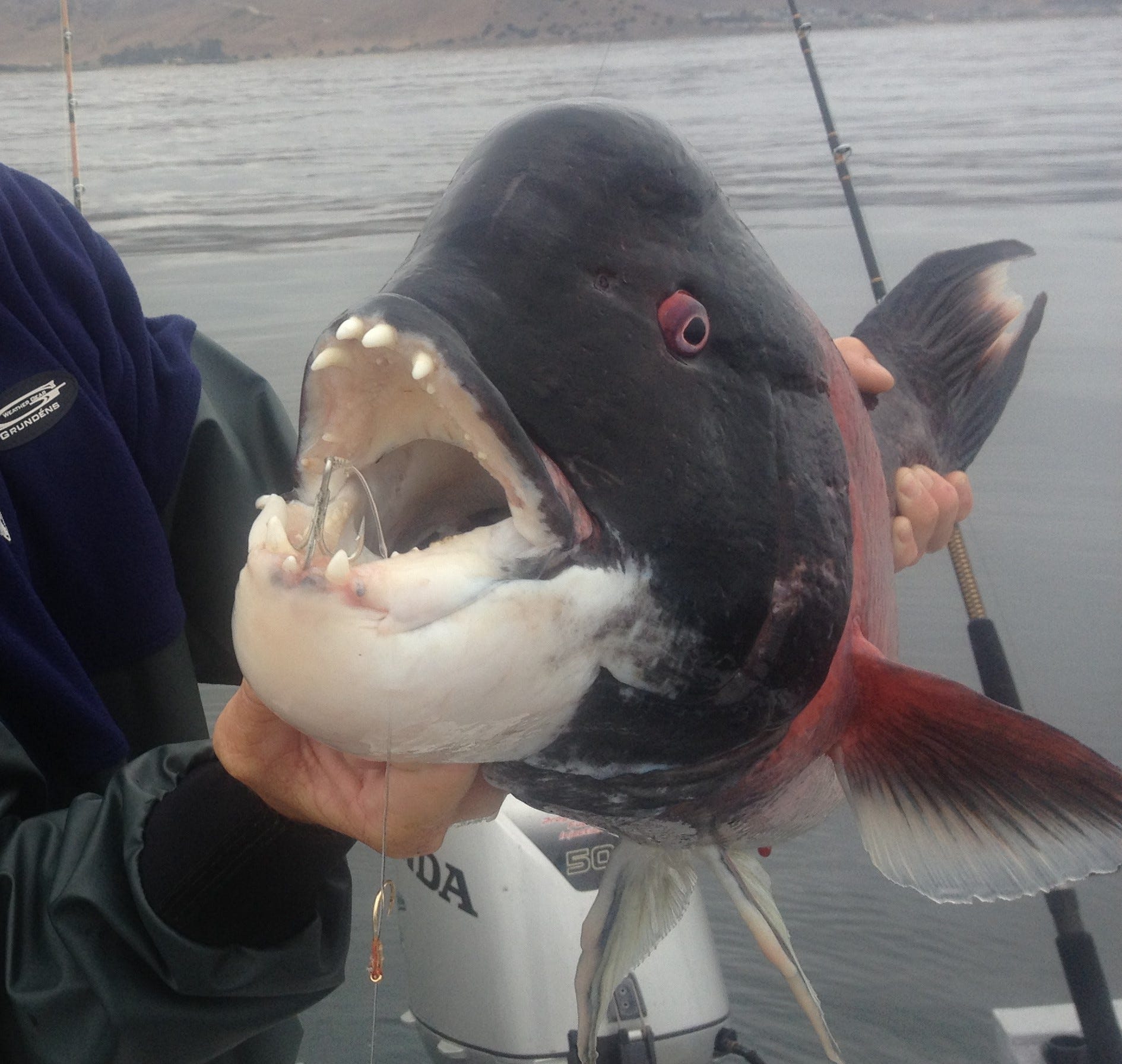
In our local waters, there is a type of wrasse called the California Sheepshead. It’s a beautiful fish with bold orange, black, and white patterns. It’s easy to see why they call it a sheepshead, as the large male’s head looks rather sheep-like. They have big, protruding canine-like teeth useful for prying hard-shelled animals from rocks like crabs, mollusks, sea urchins, barnacles, and other hard-bodied critters. After they crush the prey with their strong jaws, modified throat bones (otherwise known as a pharyngeal tooth plate) grind the shells into small pieces. The females have slightly similar teeth, are much smaller in size, and lack the sheep head profile, that is, until they mature and change their gender.
All Sheepshead’s are born female and will change sex due to a gender imbalance in the local population, or when they reach about 7-13 years old. Then, over the course of a month or two, the smaller, more slender females transition into a male, complete with a different color pattern, bigger forehead, testes, and attitude to go with it.
There are many more examples of fish out there that do this, so I’m thinking there’s no lack of material. Disney needs to get on board, hire an ichthyologist, get their writers together, and start working on the next installment for the Nemo series. I think it would be a hit. At a minimum, it would be fun to see the reviews and reactions!


